
- automating field service billing
- field service revenue leakage
- fsm
- revenue leaks
Are You Underbilling for Your Services? Plugging the Revenue Leaks in Field Maintenance
Key Takeaways:
Here’s a quick overview of how field service businesses can plug revenue leaks and improve billing accuracy:
- The Silent Drain: Revenue leaks in field maintenance are rarely caused by one massive mistake; they accumulate through unrecorded labor, forgotten materials, and incomplete documentation.
- The Visibility Gap: Weak operational tracking makes it nearly impossible to detect field service revenue leakage before the financial damage is already done.
- Time Tracking Matters: Clearly distinguishing between billable vs non-billable time is the simplest way to protect your hard-earned margins.
- Workflow Automation: Better workflows, improved field reporting, and automating field service billing are critical.
- No Extra Calls Required: Seamless field workflows allow you to capture more field service revenue from the jobs you are already doing, without overbooking your technicians.
Field service companies do not usually lose revenue to a single obvious mistake. More often, it slips away through small misses, extra labor that never gets billed, materials left off the invoice, or job details that come back too late to capture properly. Over time, those small gaps turn into real revenue leaks.
That is what makes revenue leaks in field maintenance so hard to detect. The team may look busy, customers may be satisfied, and pricing may look fine. However, the business is still losing money because the workflow between the field and the office is not capturing everything that was delivered.
This is why improving field service revenue is often less about pricing and more about process. When job data is incomplete, invoicing gets weaker. And when the workflow is cleaner, the path from completed work to revenue is much more reliable.
Where Revenue Leaks Usually Happen in Field Maintenance
Missed Labour, Travel, and Small Add-Ons
A lot of lost revenue comes from work that gets done but is not fully recorded. Extra labour, travel time, small materials, or added troubleshooting can easily be left off the final invoice when technicians are moving quickly from one job to the next.
This is where field service revenue leakage often starts. The problem is not always large missed charges. More often, it is the smaller details that are lost in the handoff between the field and the office. That is also why billable vs non-billable time becomes so important. If the team is not clearly capturing that distinction, revenue slips away quietly.
Delayed or Incomplete Billing Workflows
Revenue is also lost when completed work does not flow cleanly into billing. A report is late, a note is incomplete, or an office team member has to chase down missing details before an invoice can go out.
That makes field service billing and invoicing weak because the final invoice is only as good as the information behind it. If the handoff is messy, underbilling is much more likely.
Why Poor Visibility Makes Underbilling Worse
Underbilling becomes more difficult to correct when daily performance is not visible. Without a robust dashboard for monitoring daily revenue for field service business results, teams often work from delayed or incomplete information. Jobs may be completed, but that does not mean they were fully documented, billed, or collected.
That gap has implications beyond finance. Dispatch may not know whether extra work was added, billing may miss unlogged parts, and management may have a hard time telling whether the day was profitable or just busy. Without a reliable dashboard to monitor daily revenue and field service business performance, missed charges often go unnoticed until much later.
And that is how field service revenue gets distorted. The business can appear active on the surface, yet still lose margin due to poor handoffs and incomplete reporting.
The Real Cost of Billable vs Non-Billable Time
The line between billable and non-billable time is where a lot of revenue gets lost. Once a technician moves to the next job, reconstructing time becomes more difficult. An additional 20 minutes on site, additional diagnostics, or travel outside the original scope can easily go unbilled if they are not clearly captured.
That is why GPS tracking, accurate billing, field services, and workflows can be so useful. Location-based records help validate arrival and departure times and job movement, making it easier to compare estimated times with actual field activity. According to research published by PR Newswire, manual time-tracking methods allow one in five billable hours to slip through the cracks.
This is where Praxedo shines; it makes time capture more accurate and billing more complete. Praxedo supports that visibility by linking technician status updates, field reporting, and job activity in a single workflow rather than scattering them across calls, texts, and manual notes.
How Automation Helps Plug Revenue Leaks

Faster, Cleaner Billing Processes
Manual invoicing causes delays, additional follow-up, and increased opportunities for missed charges. That is why automated billing of field services is important. It helps to move completed work into billing faster and with fewer gaps.
Strong automated billing solutions for field services also reduce the need for re-entry and make it easier to turn field activity into invoice-ready information.
Better Job Data from the Field
Automation works best when the information coming from the field is complete. Clear notes, accurate timestamps, and properly logged materials make billing more reliable and reduce missed revenue.
That is where field service management software with billing & invoicing features comes in especially handy. It enhances field service billing and invoicing by linking technician reporting, job completion, and billing workflows into a more consistent process.
Case Study Snapshot: What Plugging Revenue Leaks Looks Like in Practice
B.B.G Refrigeration
B.B.G Refrigeration switched from paperwork orders and eliminated the risk of lost service reports. After partnering with Praxedo, the company now claims that 100% of completed reports are invoiced, and its billing cycle has gone from 15-20 days to a maximum of 5 days. That is a good example of how revenue leaks in field maintenance often start with broken documentation and slow handoffs rather than pricing itself.
Read the full B.B.G Refrigeration case study here
Neoservices Elevators
Neoservices Elevators used a more connected workflow to enhance dispatch visibility and process completed work orders in real-time. After using Praxedo, the company reports that dispatch became 50% more productive, while invoicing deadlines were reduced by 10 to 15 days, helping improve cash flow. That kind of improvement demonstrates how field service revenue leakage can be reduced when completed work moves faster into billing.
Read the full Neoservices Elevators case study here
Vari-Therm Ltd
Before digitizing its processes, Vari-Therm waited up to 2 weeks to bill clients for completed work. After changing the workflow with Praxedo, the company says invoices now go out the same day and that every completed job is accounted for. That is precisely the type of operational shift that insulates field service revenue leakage from becoming a normal cost of doing business.
Read the full Vari-Therm Ltd case study here
How to Increase Revenue Per Technician Without Adding More Calls
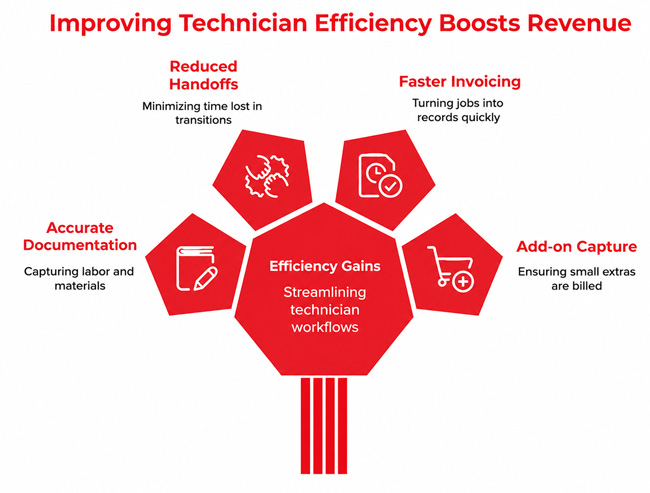
Many businesses assume the only way to make more money is to send technicians to more appointments. That is not always true. Some of the best strategies for increasing revenue per technician in field services come from improving what already happens inside the workday.
That can mean:
- Documenting labour and materials more accurately
- Reducing time lost in poor handoffs
- Turning completed jobs into invoice-ready records faster
- Making sure small add-ons do not disappear from the final bill
The most practical strategies to increase revenue per technician in field services are often the least flashy. Better forms. Clearer time capture. Faster admin flow. Stronger follow-through. All of that supports field service sales because it makes the business better at converting performed work into recognized revenue. It also enhances field service sales opportunities, as technicians who document clearly are more likely to surface additional needs, quote follow-up work, and support stronger service recommendations.
Why HVAC Companies Feel Revenue Leakage So Strongly
HVAC businesses often experience a billing gap more acutely than other service industries because the work varies so rapidly with demand, season, and urgency. Emergency calls, mixed materials, maintenance visits, callbacks, and weather-driven spikes all provide more opportunities for something to be missed between job completion and invoicing.
That is one reason why field service management platforms have become such an important question for HVAC companies. In HVAC, the issue is seldom a lack of work. The issue is whether all of that work is being captured properly. Stronger documentation, cleaner technician reporting, and faster invoice preparation are central to how field service management platforms increase revenue for HVAC companies in real operating conditions.
What Better Field Workflows Look Like
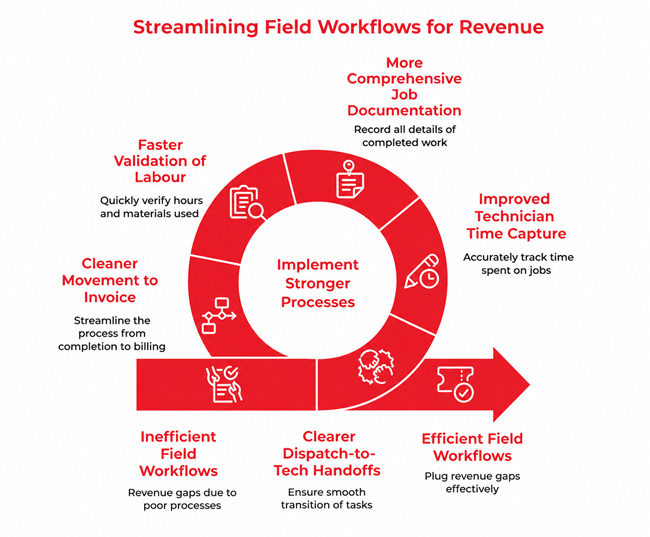
The businesses that plug revenue gaps best usually don’t solve the accounting problem first. They solve it in the workflow.
A stronger process often includes:
- Clearer dispatch-to-tech handoffs
- Improved technician time capture
- More comprehensive job documentation
- Faster validation of labour and materials
- Cleaner movement from completed work to invoice
That is where connected systems are important. Good field execution supports better billing and invoicing for field service, not because finance works harder, but because the data comes in cleaner and faster. The same is true for field service management software with billing & invoicing tools. Their value is not only in billing screens. It is in helping the business protect margin by making the field-to-office process more reliable.
Conclusion: Plug the Revenue Leaks Before They Become Routine
Most underbilling is not due to bad pricing. It comes from small pieces of value slipping through the workflow, a missed part, an unclear labour entry, or a delay between job completion and invoicing.
That is what makes revenue leaks in field maintenance so dangerous. They often feel routine until lost revenue starts to add up. Once visibility improves and the handoff between field activity and billing gets tighter, those leaks become much easier to control.
If you want to protect field service revenue and prevent small misses from becoming the norm, start by fixing the workflow behind the invoice. Book a demo with Praxedo to see how a more connected field service process can help you capture more of the revenue you already earn.
FAQs:
1. What causes revenue leaks in field maintenance?
Missing labour entries, forgotten materials, delayed paperwork, and poor field-to-office handoffs are some of the most common causes.
2. How do field service teams lose billable revenue?
They often lose it due to incomplete job notes, unclear time tracking, and services performed but not fully reflected on the invoice.
3. What is the difference between billable and non-billable time?
Billable time is work that should be charged to the customer, while non-billable time includes internal tasks or other time the business chooses not to invoice.
4. How can automation enhance field service billing?
It helps speed up reporting, reduce manual re-entry, improve invoice accuracy, and move completed work into billing more quickly.
5. How does GPS tracking help with more accurate billing?
It adds useful validation for technician movement, arrival times, and time spent on site, helping reduce disputes and improve job records.
6. What software features help reduce underbilling?
Strong mobile documentation, improved time tracking, live job visibility, and connected billing workflows are some of the most useful features.

Our similar articles.
-
- fsm
- AI in field service management
- Microsoft Dynamics 365 Business Central
- Integrations
Maximizing Field Service Efficiency: Integrating Praxedo with Microsoft Dynamics 365 Business Central
Februar 23, 2026
-
- fsm
- Top 10
- field service insights
Field Service Insights That Mattered Most – Our Top Blog Picks
June 17, 2026
-
- customer experience
- fsm
- AI
- AI in field service management
Beyond the Algorithm: Why AI Success is About People, Not Just Code
November 10, 2025