- Artificial Intelligence
- Maintenance
- Technician
- Technicien
Bringing the Benefits of Computer Vision to Maintenance Technicians
Key Takeaways:
Here’s a quick overview of how computer vision benefits maintenance technicians:
- Computer vision is an AI-based image-processing and deep-learning technology that automatically identifies defective parts in images and videos.
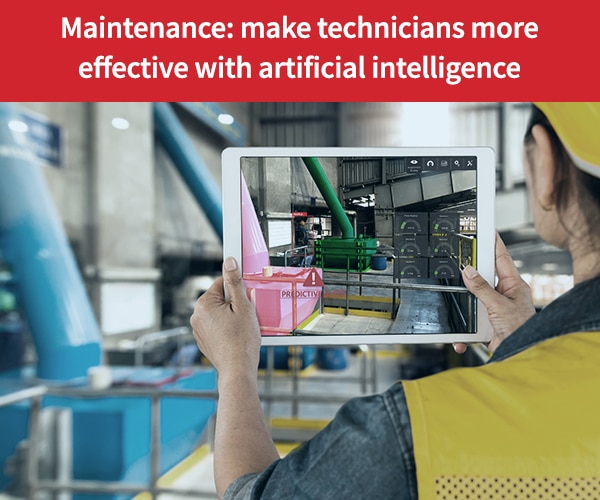
- It augments on-site technicians who are equipped only with a smartphone, providing them with real-time guidance until the work is validated.
- In quality control and predictive maintenance, it detects faults earlier and more objectively than humans, and with very low error rates.
- Utility companies use it for smart inspections, such as categorizing corrosion on utility poles that could lead to blackouts or fires.
- It is used by telecom operators such as Bouygues Telecom to test fiber connections and identify anomalies at customer sites.
Computer vision uses artificial intelligence technologies to automatically detect defective components. It “augments” on-site maintenance technicians who are equipped only with a smartphone. You’ve likely used a computer vision service without knowing it. As a sub-category of artificial intelligence, computer vision technology processes and analyzes images and videos to learn from them. This artificial vision is often used to identify individuals in photos posted on social networks. To “see” like humans, computer vision relies on image processing and deep learning technologies through neural networks. In today’s digital world, this image data permeates our daily lives and the use cases are endless, especially in the professional world.
What are the practical applications of computer vision?
With video surveillance, a camera that’s connected to artificial vision technology can automatically detect an attempted break-in at a private residence, an assault in a parking lot, a piece of abandoned luggage in an airport, a person who has collapsed on a subway platform or aggressive behavior on public transportation. And it can do this with all of the legal and regulatory safeguards required to protect peoples’ right to privacy. With the advent of connected and autonomous cars, auto manufacturers will swap out electronic sensors for smart cameras to minimize the risk of accidents. The on-board system continuously analyzes the flow of visual data from objects such as road signs and measures the distance to other vehicles and to pedestrians to make the right decisions at the right time. Computer vision also has great potential for:
- Medical imaging in healthcare
- Optimizing shelving in warehouses
- Crop disease detection using aerial photos in agriculture
- Track monitoring using drones in the railway industry
How does computer vision enhance quality control and predictive maintenance?
But it’s industrial players that have the most to gain from computer vision, especially in the area of quality control. A camera with image recognition that’s installed above a production line can immediately detect faulty parts, relieving production staff of this thankless task. Computer vision is also very useful for automated inspections of infrastructure and buildings. In predictive maintenance, computer vision can be used to identify a problem or failure before it occurs. Because the computer can endlessly manipulate image data in an objective way without ever getting tired, it can far exceed human capabilities, saving significant time and providing very low error rates.
Analytical maintenance is now possible
Once the image data is captured by the camera, it’s sent in real time to software that analyzes it and provides recommendations, such as initiating preventive maintenance when significant wear is detected on a part. We call this “analytical maintenance”. For Augustin Marty, CEO and co-founder of Deepomatic, a startup that specializes in developing image recognition solutions for manufacturers, computer vision is ideal for service management. In a column published on the French website, L’Usine Nouvelle, Marty explains that equipping technicians’ smartphones with a visual recognition application allows them to photograph each step of their installation or maintenance task to benefit from real-time notifications about the right approach to take until the work is completely validated. He then notes that “augmented technicians” save time and, thanks to the information in the application, improve the quality of their work over time. If technicians never need a return visit to readdress an issue, customers also benefit.
How does the energy industry benefit from computer vision?
As an example, the startup founder cites the need to read and maintain gas, water and electricity meters, tasks that citizens typically dread. The problem is the large number of connection errors and the mess this creates. In addition, rearranging dates can be like running an obstacle course. These rescheduled service calls are expensive for utility operators. And it’s very difficult to keep an eye on all of the work carried out by subcontractors acting on their behalf across the country. In another column for L’Usine Nouvelle, Augustin Marty highlights a use case for electricity providers: “intelligent” inspection of utility poles. If these poles are poorly maintained, or become corroded, they can cause blackouts and, in heavily forested areas, forest fires. Today, utility pole inspections are carried out by people who climb the poles and visually assess whether metal supports are corroded, or by visually inspecting photos taken by drones to determine the degree of corrosion. Considering the number of photos that must be processed, evaluations are made back at the office, not on site. Computer vision allows the data to be automatically processed in real time. It even classifies the corrosion level of metal supports as surface corrosion or puncture corrosion.
How does the telecom industry benefit from computer vision?
The energy industry is not the only one affected. Telecom operators can also use computer vision. French telecom provider, Bouygues Telecom, uses a Deepomatic quality control solution for technicians that connect fiber at customer sites. Technicians use their smartphone to take pictures of the device to be connected. The photos are sent to the cloud and analyzed by an image recognition neural network that detects anomalies such as a disconnected fiber line or a transmission fault in a cable. If a definitive determination can’t be made, the software sends an alert to the technician so they can make the final call. French national railway company, SNCF, also relies on computer vision technology to significantly increase rail safety. For the past five years, the company has been working with the technology in the areas of driving assistance, operating assistance, safety and passenger counting.
Conclusion
Computer vision is quietly transforming field maintenance, turning a standard smartphone into a powerful diagnostic tool. It improves work quality, reduces costly return visits, and enables truly predictive maintenance by catching defects in real time and guiding technicians step by step. The “augmented technician” is quickly becoming the benchmark for field service excellence in energy, telecom, and beyond as adoption grows.
Praxedo is introducing AI-based image verification to field operations, which automatically verifies work order images for quality and installation problems. Request a demo to see how AI can strengthen your field service quality control.
FAQs:
1. What is computer vision in field service maintenance?
It is a type of AI that uses deep learning to analyze images and video, automatically identifying defects and assisting technicians in maintenance procedures.
2. How does computer vision help maintenance technicians?
It allows technicians to take photos of every stage of a job on their smartphone and get instant feedback, which enhances the quality of work and minimizes repeat visits.
3. What is analytical maintenance?
It is when captured image data is analyzed in real time by software that offers recommendations, such as when part wear is detected, triggering preventive maintenance.
4. How does computer vision improve quality control?
A camera with image recognition can instantly detect faulty parts on a production line or during inspections, without fatigue and with very low error rates.
5. How do utility companies use computer vision?
It is used by providers for intelligent inspections, for example, to automatically classify the corrosion level of utility poles, helping prevent blackouts and forest fires.
6. How does the telecom industry use computer vision?
Telecom operators use it to test fiber connections at customer sites, and neural networks can detect if the line is disconnected or if there is a transmission fault.

Our similar articles.
-
- Software
- Field Service Management
- Maintenance
9 Practical Steps to Deploy FSM Software
July 19, 2018
-
- Artificial Intelligence
- Field Service Software
- AI
- AI in field service management
The Role of AI in Field Service Management
December 16, 2024
-
- Mobility
- Technician
- Mobile App
- Security
- Work orders
How to create a cybersecurity culture among field technicians
April 7, 2021