
- HVAC conditions
- HVAC inventory management
- thermostat whiplash
Thermostat Whiplash – Surviving Chicago’s 40-Degree Swings Without Burning Out Your Team
Key Takeaways:
Here’s a quick overview of why Chicago HVAC teams need a smarter way to manage thermostat whiplash during shoulder season:
- Thermostat whiplash turns one workday into a rush of both heating and cooling services.
- Chicago shoulder-season HVAC conditions create dispatch pressure, mixed inventory needs, and more challenging diagnostics.
- Short-cycling HVAC systems and changing operating conditions make “it was working fine this morning” calls more difficult to diagnose.
- Stronger HVAC inventory management, real-time parts visibility, and intelligent dispatching for the HVAC team help reduce chaos in the field.
- Better preparation, cleaner workflows, and digital tools can reduce HVAC technician burnout before peak summer demand arrives.
If you run an HVAC operation in Chicago, you know the feeling. The morning starts with no-heat calls in Logan Square; it’s 35°F and a customer’s system is acting like January never left. By early afternoon, the sun is out, the temperature jumps toward 78°F, the air feels damp off the lake, and suddenly the phones light up with cooling complaints. That daily swing is not just annoying weather. It’s thermostat whiplash.
For field teams, thermostat whiplash is what happens when one workday behaves like two separate seasons. Your technicians may move from furnace lockouts and ignition issues to condenser startup failures within a few hours. During Chicago’s shoulder season, HVAC conditions don’t arrive gradually—they stack up.
Why the Pressure Builds So Fast?
Chicago’s weather volatility is not theoretical. According to ABC7 Chicago, on February 16, 2026, O’Hare reached 65°F, breaking the previous record for that date by 7°F.
That kind of swing is exactly what turns an ordinary spring workday into a shoulder-season dispatch problem. A technician may begin the day thinking about heat exchangers, safeties, and combustion, then, by lunch, switch to refrigerant charge, airflow, and capacitor failure. Doing that once is manageable. Doing it four times in one shift is mentally exhausting. Over time, that constant switching contributes to HVAC technician burnout, especially when every customer believes their issue has to be solved immediately.
The dispatch side is no easier. When temperatures swing fast, the board fills up with calls that all sound urgent by 4:00 PM. Without better visibility and structure, the day turns reactive. And that is where HVAC service technician burnout often starts, not from the weather alone, but from a workflow that was never built to flex with it.
The Hidden Cost of Thermostat Whiplash

Mechanical Stress and Harder Diagnostics
One of the less obvious costs of wild spring swings is equipment behavior. Sudden temperature reversals can push equipment into awkward operating cycles, especially in homes where systems are already aging or marginal. That is why short-cycling HVAC systems become such a real concern during spring and fall. A unit may appear stable during a cold morning, only to behave differently after the home warms up and humidity rises later in the day.
For the customer, that feels confusing. They say, “It was working fine this morning.” For the technician, that statement can be a trap. Diagnosing short-cycling HVAC systems is harder when the operating conditions shift dramatically within the same day. You are not just solving a fault. You are solving a moving target.
In other cases, a customer describes an HVAC unit frozen in winter and assumes the entire system is dead, when the actual story is more complicated. During these transition weeks, old problems and new ones collide.
Inventory Chaos on the Truck
Shoulder season would be easier if every truck could be stocked with a single category of failure. Chicago doesn’t allow that luxury. On the same day, one technician may need furnace igniters in the morning and a 45+5 capacitor by late afternoon. That is where HVAC inventory management becomes more than a warehouse concern. It’s evolved into a field survival issue.
Mixed demand is what makes shoulder season HVAC service so frustrating. If you load trucks heavily for cooling, you risk being underprepared for early heating calls. If you stock for winter, you may lose time on the first warm burst of AC breakdowns. Poor HVAC inventory management during these weeks almost always leads to extra calls back to the shop, delayed repairs, or unnecessary second visits.
This is also where real-time parts visibility starts to matter in practice. A technician standing in a driveway should not have to phone the warehouse, wait for an answer, and hope someone checks the right shelf. They need real-time parts visibility on the spot, not because it sounds modern, but because it saves the day when the weather decides to turn sideways by lunchtime.
Burnout Before the Summer Rush Even Begins
The most expensive part of weather chaos is often your people. Chicago’s erratic shoulder seasons create unpredictable overtime, abrupt schedule extensions, and a low-grade tension that follows the team all day. This is where HVAC technician burnout creeps in before summer even arrives.
And when the operation still runs on paperwork orders, scattered texts, or group chats that read like emergency threads, the strain gets worse fast. What should be a manageable seasonal spike starts to feel personal. Technicians are not just solving mechanical issues; they are fighting a process that keeps changing under them. That is how HVAC service technician burnout starts affecting morale, consistency, and eventually retention. In 2023, ACHR News reported that there is currently a shortage of 110,000 HVAC technicians, with about 25,000 technicians leaving their companies each year, which makes efficiency and retention critical for service businesses.
This is one of the reasons platforms like Praxedo matter during unpredictable weather. Praxedo helps create structure rather than the chaos that usually takes over, which is exactly what the shoulder season demands.
What Breaks First When Your Workflow Isn’t Built for Shoulder Season
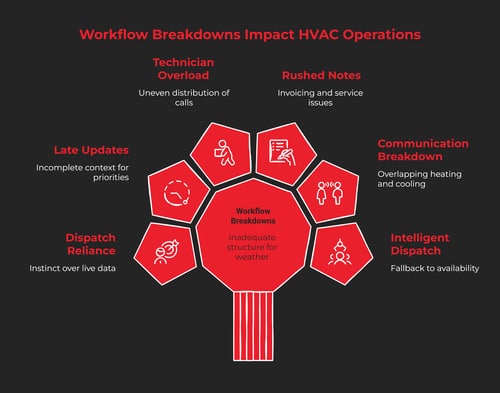
When your operation is not built for fast weather swings, the same weak points usually show up first:
- Dispatch starts relying on instinct instead of live information.
- Status updates come in late, so priorities shift with incomplete context.
- One technician gets overloaded while another is sent to the wrong type of call.
- Job notes are rushed, which creates problems in invoicing and service history.
- Field communication starts breaking down as heating and cooling calls overlap.
- Teams fall back on whoever is next available instead of using skill-based routing and intelligent HVAC dispatching.
Without a better structure, these small breakdowns add up quickly during Chicago’s shoulder-season HVAC conditions.
Operational Strategy: Taming the Shoulder Season
The fix is not simply working harder in April and May. The fix is building a field operation that can pivot without falling apart.
Intelligent Dispatching Beats “Next Available”
A Chicago team cannot treat shoulder season like a flat scheduling problem. The boiler expert should not automatically take the afternoon cooling failure just because he happens to be closest. The AC specialist should not get buried in morning no-heat calls when another technician can handle those faster. That is where intelligent HVAC dispatching earns its value.
Skill-based routing matters more during Chicago’s shoulder-season because the weather constantly changes the call mix. When your dispatch process reflects technicians’ strengths, the day becomes calmer for everyone: the office, the customer, and the driver.
Parts Data Has to Reach the Field
The same principle applies to stock visibility. If a technician needs confirmation that a capacitor, igniter, or contactor is available, they should not have to wait for the warehouse to tell them. They should be able to see it instantly.
That is not a luxury feature. It is operational control. Praxedo supports the HVAC industry with faster decision-making by helping teams access the information they need while the job is still in motion, not after momentum is lost.
The Revenue Opportunity Hidden Inside the Chaos
Shoulder season is not only a stress test. It is also a window for better service conversations.
Lake-Effect Moisture Creates a Real Comfort Problem
When the lake air turns sticky, customers may complain that the house feels damp even before summer heat really settles in. That discomfort gives your team a chance to recommend practical solutions instead of treating every visit like a one-line repair.
The Dehumidification Upsell
This is where dehumidification, higher-efficiency filtration, and airflow improvements become valuable. A technician who is trained to spot moisture issues can turn a reactive call into a better outcome for the homeowner and a stronger ticket for the business. In cities where humidity can make a 78°F day feel heavier than it should, those “hero” installs are often the ones customers remember in May and September.
Preparing for the “May Surge” with Better Data
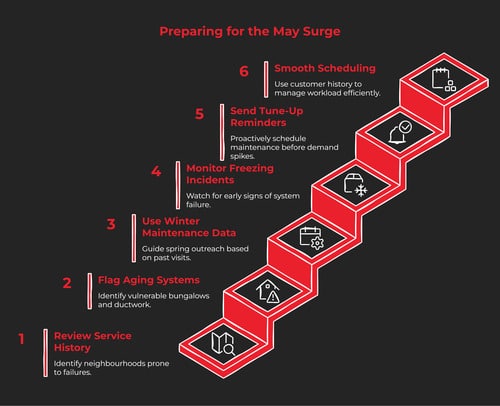
The best teams do not wait for the first 80°F day to expose every weak system. They prepare in advance by using data more intentionally:
- Review service history to identify neighborhoods most likely to fail first.
- Flag aging bungalows, older ductwork, and equipment that struggled through winter.
- Use records from HVAC winter maintenance visits to guide spring outreach.
- Watch for earlier cases involving an HVAC unit freezing up in winter.
- Send tune-up reminders in April instead of waiting for June demand to spike.
- Use customer history to smooth scheduling before the rush turns reactive.
That kind of preparation helps turn winter HVAC maintenance data into a more stable spring workload.
Conclusion: Scale with the Weather, Not Stress
Chicago weather will keep doing what it does. One day will still feel like March at breakfast and June by midafternoon. The question is whether your operation has to feel that same instability.
The difference between a profitable shoulder season and a draining one usually comes down to infrastructure. Better routing, stronger documentation, cleaner parts visibility, and smarter preparation all make it easier to absorb fast-changing demand without burning out the people doing the work. That is the real answer to thermostat whiplash.
Managing 40-degree swings takes more than grit. It takes a digital backbone. Praxedo helps Chicago HVAC teams stay steadier with better scheduling, faster field access to information, and a workflow built to handle weather-driven demand without losing control. Book a demo with us to see how your team can stay ahead of Chicago’s shoulder-season chaos this year.
FAQs:
1. What is thermostat whiplash in HVAC?
It’s the rapid shift between heating and cooling service demand caused by sharp temperature swings on the same day.
2. What is the biggest operational challenge during Chicago’s shoulder season?
The biggest challenge is managing sudden shifts in demand without overloading dispatchers, technicians, or truck inventory.
3. Why is Chicago’s shoulder season so hard on HVAC operations?
Cold mornings, warm afternoons, and lake-driven humidity can create overlapping heating and cooling calls, which puts pressure on dispatch, inventory, and technicians.
4. How do rapid weather swings affect HVAC systems?
They can cause systems to behave inconsistently, increase the risk of short-cycling, and make diagnosis more difficult for technicians.
5. Why does parts visibility matter during shoulder season?
Because technicians may need heating and cooling parts in the same shift, delays in finding stock can slow repairs and increase callbacks.
6. How can HVAC companies reduce technician burnout during shoulder season?
Better scheduling, cleaner communication, stronger service history, and faster access to parts all help reduce stress and keep teams more productive.
