
- ai scheduling
- scheduling software
- scheduling spreadsheets
- spreadsheet schedule
Praxedo vs. Paper Spreadsheets – The True Cost of Your Current Scheduling Method
Key Takeaways:
Before diving in, here’s a quick overview of why moving from spreadsheet-based scheduling to a structured digital system is essential for Chicago HVAC companies:
- The Scale Bottleneck: Manual scheduling becomes increasingly chaotic as your technician team expands and seasonal weather demands intensify.
- Hidden Administrative Drain: Dispatch teams spend hours manually updating files and routes—labor costs that quickly add up.
- Fragmented Visibility: Keeping dispatch, inventory, and job histories in separate, disconnected spreadsheets leads to scheduling conflicts and missed billing opportunities.
- Dynamic Route Optimization: Static sheets cannot adapt to real-world disruptions like sudden Chicago traffic gridlock or emergency call-outs.
- Standardized Quality: Moving to digital dispatch ensures uniform service delivery, especially when managing complex multi-location commercial maintenance contracts.
Chicago HVAC operators battle one of the most demanding climates in the country. Between brutal sub-zero winters, humid summer spikes, notorious highway gridlock, and a massive service footprint stretching from the Loop out to the collar suburbs, dispatchers face constant scheduling pressure.
Despite this, most HVAC firms in Chicago still use paper-based systems or spreadsheets to schedule technicians for daily dispatch.
Although spreadsheets might seem cost-efficient, their shortcomings become more pronounced as service volume increases. Knowing the actual financial and operational cost of a spreadsheet schedule is critical to contractors who want to grow sustainably.
The Current State of Spreadsheet Scheduling in Chicago’s HVAC Sector
Why Spreadsheet-Based Systems Remain Common
Spreadsheets are popular due to their availability and flexibility. A dispatcher can set up a basic scheduling spreadsheet without any special training. Job assignments, time blocks, and technician names can be organized quickly.
But in reality, one scheduling file often becomes several scheduling spreadsheets. Appointment tracking may exist in one document, inventory data in an HVAC inventory spreadsheet, and job completion records in an HVAC work spreadsheet.
These systems operate independently. Updates have to be made manually across files, which increases administrative burden and reduces real-time visibility.
This structure can work well in a moderate workload setting. In Chicago’s peak heating and cooling seasons, it introduces measurable operational strain. According to Grand View Research, the U.S. HVAC systems market is projected to reach USD 54.02 billion by 2033, reflecting sustained demand across residential and commercial sectors.
Structural Limitations in High-Demand Conditions
The service environment in Chicago presents logistical challenges that cannot be easily addressed with spreadsheets. Dynamic coordination is required to address traffic variability, emergency calls, technician specialization, and multi-location commercial contracts.
A static Excel sheet cannot automatically reroute a technician caught in bumper-to-bumper traffic on I-90 or the Eisenhower, nor can it dynamically reassign an emergency call-out. Instead, dispatchers must waste valuable time calling around to find out who is closest.
The Financial and Operational Costs of Manual Scheduling

Administrative Overhead and Lost Productivity
The shortest-term expense when using a spreadsheet to schedule is administrative time. The dispatch teams are required to keep assignments up to date, confirm availability, check inventory levels, and record completed jobs.
During a classic Chicago January freeze, emergency calls flood in simultaneously. The time spent manually updating a spreadsheet to keep pace with these bursts of demand completely overwhelms dispatch teams, pulling them away from customer service.
Additionally, the process of finding the optimal scheduling method for several HVAC technicians per day is complicated by manual coordination. In the absence of automated optimization, routing decisions are often made based on experience rather than data, limiting efficiency.
Error Risk and Customer Impact
Manual systems increase the risk of duplicate bookings, incomplete records, and obsolete inventory records. A mistake in the HVAC inventory spreadsheet can lead technicians to arrive without the required parts. The HVAC work spreadsheet may have delayed updates, reducing visibility into job status.
According to Forbes, “88 percent of all spreadsheets contain significant errors”. For HVAC contractors managing complex dispatch operations, this reinforces the value of transitioning to centralized scheduling solutions such as Praxedo.
Service reliability is a key factor in retention and referral growth in Chicago’s competitive HVAC market. Firms with poor coordination can lose repeat business to firms with more streamlined systems.
Managing Multiple Technicians Across Chicago Requires Greater System Integration
Scaling Beyond Basic Scheduling Tools
As HVAC companies expand their workforce, complexity increases disproportionately. The process of organizing a small team in a spreadsheet schedule is quite different than organizing several crews in the city and the suburbs.
Contractors who want to schedule multiple HVAC technicians in a day should consider geography, skill sets, job duration, and priority. Static scheduling spreadsheets lack built-in intelligence to optimize these variables in real time.
Multi-Location Maintenance and Standardization
Commercial and institutional clients typically require preventive maintenance across multiple properties. Implementing best practices for scheduling HVAC maintenance across multiple locations demands centralized oversight and consistent execution.
Trying to coordinate these complex requirements in a manual spreadsheet increases the risk of oversight. Each additional property, technician, or contract adds another layer of coordination.
As growth accelerates, spreadsheet-based processes transition from manageable to restrictive.
When to Replace Spreadsheets with Scheduling Software
Identifying the Inflection Point for Growth
The transition from spreadsheets to digital scheduling platforms typically occurs at a measurable inflection point. This point is not defined by company age, but by operational strain.
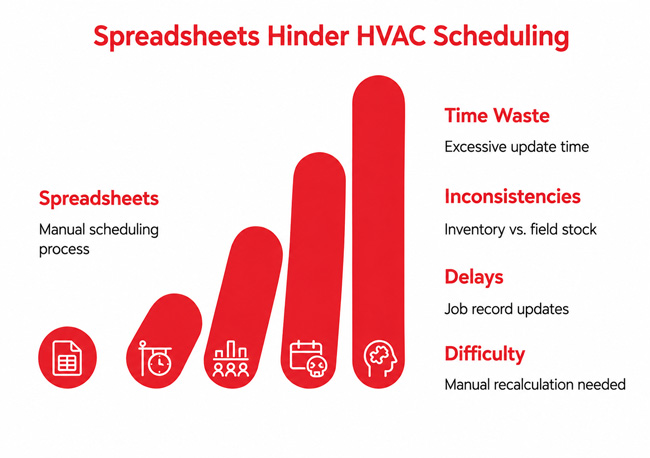
Common indicators include:
- Dispatch teams are spending excessive time updating a spreadsheet for scheduling employees
- Increasing reliance on multiple scheduling spreadsheets to track technicians, vehicles, and appointments
- Recurring inconsistencies between the HVAC inventory spreadsheet and actual field stock
- Delays in updating job records inside the HVAC work spreadsheet
- Difficulty determining the best way to schedule multiple HVAC technicians per day without manual recalculation
At this stage, leadership often begins evaluating when to replace spreadsheets with scheduling software. The question shifts from “Can we manage?” to “Can we scale efficiently?”
For Chicago HVAC contractors operating in a climate-driven demand cycle, scalability is not theoretical. It determines whether the business can respond effectively during peak winter and summer periods.
Why Scheduling Software for HVAC Outperforms Spreadsheets
Real-Time Visibility and Operational Control
Unlike static files, HVAC scheduling software provides centralized visibility into dispatch, technician activity, and job progress. Managers can monitor assignments, dynamically adjust schedules, and reduce administrative friction.
This level of control supports contractors seeking the best HVAC scheduling software for teams with multiple technicians. Automated routing, technician skill matching, and workload balancing reduce dependency on manual adjustments within a spreadsheet schedule.
Integrated systems also streamline how HVAC companies manage their daily technician schedules in competitive markets. Rather than relying on fragmented scheduling spreadsheets, companies gain structured workflows and synchronized data.
Standardization Across Multi-Location Service Areas
Commercial clients often need structured preventive maintenance programs. Best practices for scheduling HVAC maintenance across various locations require centralized management.
The lack of centralized logic in a spreadsheet makes it impossible to maintain uniform standards as the team grows. As contracts expand, spreadsheet-based processes shift from flexible to restrictive.
Scheduling Software vs. Spreadsheets: A Financial Perspective for Chicago HVAC Companies

The Real Administrative Cost
A spreadsheet schedule may seem inexpensive because it carries no subscription fee. However, maintaining multiple scheduling spreadsheets requires ongoing manual data entry and oversight.
Dispatchers must update technician assignments, verify availability, reconcile notes, and confirm inventory data stored in an HVAC inventory spreadsheet. As service demand increases across Chicago, these administrative tasks expand proportionally.
The time spent managing a spreadsheet for scheduling is not directly tracked, but it is a quantifiable operational cost. What seems cost-effective initially often becomes labour-intensive as the business expands.
Inefficiencies That Reduce Daily Revenue
Manual systems limit flexibility. Without automation, implementing the best way to schedule multiple HVAC technicians per day becomes increasingly complex as the team expands.
Route planning must be handled manually. Schedule changes require constant revision. When updates in the HVAC work spreadsheet lag behind field activity, visibility declines, and billing cycles can slow.
In high-demand periods, especially during winter emergencies in Chicago, static scheduling spreadsheets reduce responsiveness. Over time, these inefficiencies translate into fewer completed jobs per technician and reduced daily revenue capacity.
Inventory and Multi-Location Coordination Challenges
Coordinating parts and maintenance schedules through disconnected files creates structural risk. An inaccurate update in an HVAC inventory spreadsheet may delay service calls. Equally, inconsistent documentation is a challenge to ensuring uniformity in commercial contracts.
Firms aiming to adopt best practices for scheduling HVAC maintenance across multiple sites require centralized management. Attempting to manage these standards in a spreadsheet for employee scheduling increases the likelihood of oversight as operations scale.
Software as a Strategic Upgrade
The current HVAC scheduling software integrates dispatch, technician tracking, and reporting into a single platform. The most suitable HVAC scheduling software for teams with more than one technician supports real-time schedule changes, an organized workflow, and more efficient technician utilization.
For decision-makers evaluating the best software for managing HVAC service technicians and scheduling, integration is critical. Instead of using disjointed documents, integrated systems offer visibility into operations.
This is where Praxedo becomes strategically relevant. Praxedo is designed specifically for field service operations and reduces dependency on isolated spreadsheets. Praxedo facilitates scalable coordination across Chicago’s service areas and enhances operational transparency.
Long-Term ROI and Competitive Positioning
The HVAC market in Chicago is climate-driven, and operational accuracy is a direct determinant of profitability. Firms that are highly dependent on spreadsheets often struggle to understand technician utilization, response times, and scheduling efficiency.
In comparison, structured digital platforms offer quantifiable performance information. Understanding how HVAC companies manage their daily technician schedules at scale reveals a consistent pattern: integrated systems support stronger growth trajectories.
Praxedo enables contractors to shift from reactive coordination to proactive management. Since demand is seasonal, Praxedo enables managers to make changes without reorganizing their entire scheduling process.
Conclusion: Evaluating the Strategic Impact of Your Scheduling Method
For HVAC companies in Chicago, scheduling is not an administrative task. It is a strategic role that determines revenue, customer satisfaction, and operational efficiency.
An employee scheduling spreadsheet can be used as an entry-level solution. But as technician teams grow and service areas expand, the constraints of manual coordination become more evident.
The timing of the switch from spreadsheets to scheduling software ultimately depends on growth goals. Don’t wait for another dispatch error to cost you a customer. Contact us today and make sure your scheduling system is built to handle Chicago’s toughest seasons.
FAQs:
Is a spreadsheet for scheduling employees sufficient for small HVAC teams?
A spreadsheet can work in the short term with very small teams that make a limited number of calls each day. Scalability constraints, however, are soon realized as workload and service areas grow.
What are the main risks of using scheduling spreadsheets in Chicago?
The main risks are human mistakes, ineffective routing in traffic jams, disconnected inventory management, and poor real-time visibility during peak seasons.
When should an HVAC company replace spreadsheets with scheduling software?
Company transitions usually occur when administrative burdens grow, coordination becomes uneven, and manual operations limit expansion.
What features define the best HVAC scheduling software for teams with multiple technicians?
The key features are real-time dispatching, route optimization, matching technician skills to assignments, centralized reporting, and built-in inventory tracking.
How does scheduling software improve multi-location maintenance management?
It standardizes preventive scheduling, automates recurring service intervals, and provides uniform documentation across all properties.
How does Praxedo compare to traditional spreadsheet-based scheduling methods?
Unlike static spreadsheets, Praxedo centralizes dispatch, technician tracking, and job documentation within a single platform. This minimizes manual updates, enhances real-time visibility, and reduces coordination errors.

Our similar articles.
-
- Productivity
- Field Service Management
- Productivité
- Mobile app
- scheduling software
- saas
Combining SaaS and a mobile app has huge advantages for field service
June 2, 2022
-
- fsm
- AI in field service management
- ai scheduling
- smart scheduling
How Does CBRE Schedule Tens of Thousands of Technicians Across 100 Countries?
April 26, 2026
-
- Field Service Management
- scheduling software
- Service Technician
Service Technician Scheduling App: How to Get More Hours Back in Your Day
August 8, 2023